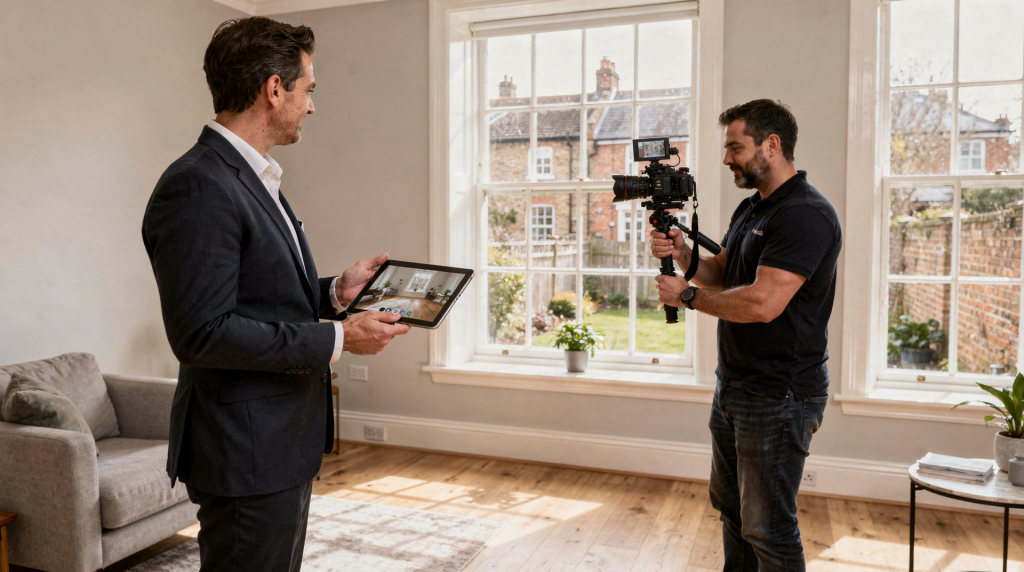
Estate agents in England do not need to choose one format forever, but they do need to choose the right format for the right listing. Virtual tours work best when the goal is to help buyers explore layout and flow at their own pace, while property videos are stronger for emotional impact, social media reach, and highlighting the lifestyle around the home.
Why this decision matters
A listing with the wrong media mix can waste time, attract the wrong audience, or fail to build enough interest before viewings. In practice, the best result usually comes from matching the format to the instruction, the property type, and the buyer journey.
For some homes, a virtual tour reduces unqualified enquiries and helps serious buyers self-select. For others, a polished video creates momentum, gets shared more often, and makes the property feel memorable. I’ve seen agents pour budget into a glossy video for a complex split‑level flat, only to field endless calls from confused buyers who still couldn’t picture the layout. Equally, a 360° tour of a lifestyle‑led cottage with stunning views often sits unviewed because it lacks the immediate emotional hook that stops a thumb on Instagram. The cost of getting this wrong isn’t just money — it’s missed opportunities and a slower sales cycle.
What each format actually does
Virtual tours
A virtual tour is an interactive experience that lets the viewer move through rooms, click between areas, and often inspect the property at their own pace. In the UK market, tours are commonly hosted as branded links or embeds for websites and property portals, and many providers also include floor plan navigation and room‑to‑room movement. From a practical standpoint, a well‑executed tour gives the buyer a sense of control — they decide where to look next, how long to stay in the kitchen, and whether to double‑check that awkward corner. This autonomy builds confidence and reduces the anxiety of the unknown, which is exactly what you want before a physical viewing.
Property videos
Property video is a guided visual story, usually edited into a linear walkthrough. It can be cinematic, practical, or social‑first, but the key difference is that the viewer follows the sequence chosen by the creator rather than controlling the route. Think of it as a curated open house: you lead the eye from the kerb appeal through the entrance hall, pause on the light flooding the living room, and finish with the garden at golden hour. The pacing, music, and shot selection all work together to create a feeling — something a tour rarely achieves on its own. But that same control means you can also hide flaws or skip over awkward transitions, which is why honesty in editing matters so much.
Virtual tours vs property videos: the core difference
| Feature | Virtual tour | Property video |
|---|---|---|
| Viewer control | High — the user explores on their own | Low — the agent controls the sequence |
| Best for | Layout, navigation, serious buyers, filtering viewings | Emotion, storytelling, social media, first impressions |
| Typical format | Interactive 360 or Matterport‑style experience | Edited walkthrough, voiceover, music, drone, and room highlights |
| Buyer experience | Practical and investigative | Fast, polished, and persuasive |
| Portal use | Often embedded or linked on websites and portals | Often used on websites and social platforms |
Beyond the table, there’s a technical nuance agents often overlook: virtual tours demand stable internet and can frustrate mobile users if the interface is clunky. Videos, on the other hand, are built for mobile consumption — they autoplay, they’re silent‑friendly with captions, and they fit the vertical scroll. That’s why a tour might impress a desktop researcher but lose a smartphone scroller in seconds.
When virtual tours are the better choice
Virtual tours are strongest when the property layout is a major selling point or when you want buyers to understand the home before booking a viewing. UK agencies often use them to help buyers walk through a property online and reduce time‑wasting viewings. A good tour answers the question “Will my furniture fit?” without a single phone call.
Use a virtual tour when:
- The property has an unusual layout, split levels, or multiple floors.
- You are selling remotely to out‑of‑area buyers.
- The home is high‑value and buyers want a detailed pre‑viewing experience.
- The listing has lots of internal features that are hard to understand from photos alone.
- You want to qualify leads and save time on physical viewings.
Best property types for virtual tours
- Larger family homes
- New‑build developments
- Apartments with complex layouts
- Premium or bespoke homes
- Investment properties
- Lettings listings where speed and convenience matter
Strengths of virtual tours
- They show flow, scale, and room connections clearly. A buyer can grasp in seconds that the dining room opens directly onto the patio — something a photo set might miss.
- They help buyers feel more confident before viewing. When someone has already “walked” the property, the in‑person visit becomes confirmation, not discovery.
- They can reduce unnecessary appointments by filtering casual browsers. If a buyer realises the third bedroom is too small for their needs, they won’t book a viewing.
- They work well on agency websites and can be embedded alongside floor plans and photos, creating a complete digital pack.
Weaknesses of virtual tours
- They can feel clinical if the visuals are poorly lit or badly composed. Harsh shadows, blown‑out windows, or a camera height that’s too low instantly cheapen the experience.
- They do not always create strong emotional pull. A tour is a tool for the head, not the heart.
- Some users still need guidance to understand what they are seeing. Without narration or visual cues, a first‑time viewer might miss the best features.
- A tour that is too technically heavy can frustrate mobile users. Long load times or fiddly navigation mean the viewer drops off before the tour even starts.
When property videos are the better choice
Property videos are better when the aim is to create desire quickly. They are especially useful for social media, where movement, pacing, music, and storytelling matter more than navigation. A well‑cut video can stop a scroll in under two seconds — a tour link cannot.
Use property video when:
- The home needs a stronger emotional hook.
- You want to promote a listing on Instagram, TikTok, Facebook, or YouTube.
- The property has a strong lifestyle angle, such as views, gardens, entertaining spaces, or local amenities.
- You want a short attention‑grabbing asset for paid promotion.
- The listing needs to stand out in a crowded market.
Best property types for video
- Lifestyle‑led homes
- Architect‑designed properties
- Homes with outdoor space or standout views
- Period properties with character details
- Show homes and developments
- Listings aimed at social‑first audiences
Strengths of property video
- It is easier to consume quickly. A 60‑second edit fits the modern attention span perfectly.
- It creates mood and aspiration faster than a tour. Music, pacing, and smooth camera moves can make a modest terrace feel like a sanctuary.
- It is highly shareable on social platforms. A compelling video gets saved, shared, and re‑watched, extending organic reach far beyond the portal listing.
- It can combine interior shots, exterior shots, drone footage, and neighbourhood context. This layered storytelling builds a complete picture of the lifestyle, not just the square footage.
Weaknesses of property video
- It can hide practical details if the edit is too stylised. Fast cuts and heavy colour grading might look stunning but leave buyers unsure about room proportions.
- Viewers may enjoy the video without becoming serious leads. A beautiful film can generate likes but not viewings if there’s no clear call to action.
- It is weaker for checking layout and room relationships. You can’t pause and look left when the camera has already moved on.
- A rushed video with shaky movement or poor pacing can damage the listing. Nothing says “unprofessional” like a jerky walkthrough shot on a phone without a gimbal.
Which one should estate agents use?
The answer depends on the job the content needs to do. I always tell agents to start with the buyer’s biggest question. If the question is “How does this home work?”, reach for a tour. If it’s “Can I see myself living here?”, pick video.
Choose a virtual tour if the priority is:
- Pre‑qualifying buyers
- Showing layout clearly
- Supporting serious decision‑making
- Reducing unnecessary physical viewings
- Giving remote buyers confidence
Choose property video if the priority is:
- Attention on social media
- Emotional engagement
- Brand‑building
- Premium presentation
- Wider top‑of‑funnel reach
The best strategy for most English estate agents
For most listings, the strongest approach is not either/or. It is a combined media stack:
- Professional photography for the hero images.
- A virtual tour for layout and navigation.
- A property video for emotion and reach.
- A floor plan to anchor the spatial story.
- Short social cutdowns to promote the listing across channels.
This works because each format answers a different buyer question. Photos answer “Does it look good?” Virtual tours answer “How does it flow?” Videos answer “How does it feel?” When you layer them, you guide the buyer from casual interest to confident enquiry without gaps in the story.
How to decide in practice
Use this simple framework before ordering media.
| Listing question | Better format |
|---|---|
| Do buyers need to understand the layout first? | Virtual tour |
| Do we need more social reach and shares? | Property video |
| Is the home complex or large? | Virtual tour |
| Is the property lifestyle‑led or highly visual? | Property video |
| Are viewings too time‑consuming? | Virtual tour |
| Is the listing struggling to stand out? | Property video |
| Do we want both filtering and persuasion? | Use both |
What buyers in England expect
In England, buyers are used to seeing photos first, then increasingly expect richer digital presentation when a listing is competitively priced or in a busy market. Virtual tours are especially useful where buyers are comparing multiple homes online and want to narrow the shortlist efficiently. The pandemic accelerated this shift, and now a missing tour can feel like the agent is hiding something — even when the layout is straightforward.
A video, meanwhile, performs better when the audience is scrolling quickly and needs an immediate reason to pause. That makes it especially valuable for social promotion, new instructions, and launches where the first 48 hours matter. A well‑timed video on a Wednesday evening can generate more qualified calls than a portal listing left to sit over the weekend.
A practical workflow for agents
Step 1: define the goal
Ask whether the listing needs qualification, attention, or both. Be honest: a city‑centre studio might need social buzz more than a 3D tour, while a five‑bed rural home demands layout clarity above all else.
Step 2: match the format to the property
- Use virtual tours for clarity and filtering.
- Use video for emotion and reach.
Don’t force a tour onto a property that photographs beautifully but has a predictable layout — you’ll waste budget and the tour will gather dust. Similarly, a video of a rabbit‑warren flat without a clear narrative will confuse rather than convert.
Step 3: plan the shoot around the buyer journey
- Lead with the strongest room. In a video, open on the wow factor; in a tour, make sure the first clickable area is the most impressive space.
- Keep circulation natural. In tours, avoid dead ends that force the viewer to backtrack awkwardly. In videos, move through the home as a buyer would — from entrance to living to private spaces.
- Avoid repetitive coverage. Don’t show the same corner from three angles unless it reveals something new.
- Capture the exterior and arrival experience. The front door, the driveway, the street view — these set expectations before the interior story begins.
Step 4: keep the visuals honest
Over‑editing can create disappointment at viewing stage. The best property media is attractive but accurate. I’ve seen buyers walk out of a viewing within two minutes because the reality didn’t match the wide‑angle magic of the video. Slight colour correction and lens correction are fine; removing power lines or making rooms look 30% larger is not.
Step 5: distribute properly
- Embed tours on the listing page. Don’t bury the link behind a tiny icon — make it a prominent part of the media gallery.
- Use videos on social channels and email campaigns. Native uploads (not YouTube links) perform far better on Instagram and Facebook.
- Repurpose short clips into reels, stories, and paid ads. A 15‑second vertical cut from the main video can become a powerful lead magnet.
Common mistakes to avoid
- Using a virtual tour without strong photography. The tour might be the deep dive, but the photos are the invitation. Weak stills kill click‑through before the tour ever loads.
- Posting a glossy video that hides the actual layout. Style over substance leaves buyers feeling misled.
- Making every listing use the same media package. A one‑size‑fits‑all approach ignores the unique story of each home.
- Forgetting mobile users. Tours that require pinching and zooming on a small screen, or videos that don’t work without sound, alienate the majority of your audience.
- Treating video and virtual tours as competing products instead of complementary tools. They answer different questions and belong in the same marketing toolkit.
- Ignoring the property type, buyer profile, and local market conditions. What works for a city flat won’t necessarily work for a village cottage.
- Shooting without basic preparation. Cluttered surfaces, poor lighting, and unmade beds sabotage even the best camera equipment. A quick declutter and turning on all lights takes minutes but transforms the result.
Checklist: should you use a virtual tour, a property video, or both?
- The property has a complex layout.
- The seller wants fewer wasted viewings.
- The audience is remote or relocating.
- The listing needs better social media performance.
- The home is visually strong but hard to explain in photos.
- You want stronger lead qualification.
- You need both practical detail and emotional impact.
If you checked mostly layout and qualification needs, prioritise a virtual tour. If you checked mostly attention and aspiration, prioritise a property video. If you checked both, use both.
Conclusion
Virtual tours and property videos are not interchangeable. Virtual tours help buyers understand a property; videos help them feel it. For estate agents in England, the smartest choice is to match the format to the listing objective, then combine both where the budget and property value justify it.
If a home is hard to understand, start with a virtual tour. If a home is easy to understand but hard to ignore, start with video. If the instruction needs both clarity and persuasion, use both and let each asset do the job it does best. The agents who master this balance aren’t just marketing homes — they’re building trust, saving time, and closing deals faster.
FAQ
Are virtual tours better than property videos for estate agents?
Not universally. Virtual tours are better for layout, qualification, and detailed exploration, while property videos are better for emotional impact and social media reach. The “better” format is the one that aligns with the listing’s primary goal.
Do virtual tours help sell properties faster?
They can help by reducing unnecessary viewings and attracting more serious buyers, especially when the layout is important. A tour filters out mismatches early, so the viewings you do conduct are warmer and more likely to convert.
Are property videos worth it for lower‑value listings?
Yes, if the goal is social visibility or faster attention. Even a shorter, simpler video can outperform a static listing on social platforms. A 30‑second phone‑shot walkthrough with good natural light can generate more enquiries than a full photo set with no video at all.
Should every estate agent offer both?
Not necessarily, but most agencies will benefit from both formats across their portfolio. The best choice depends on the property, audience, and marketing objective. Rather than offering both for every instruction, build a flexible media menu and apply it intelligently.
What should come first: video or virtual tour?
For most listings, start with photography and then decide whether the property needs a virtual tour, a video, or both. Photos remain the foundation, while video and tours solve different problems. If you must sequence them, let the buyer’s journey dictate: use video to attract, then a tour to convert.